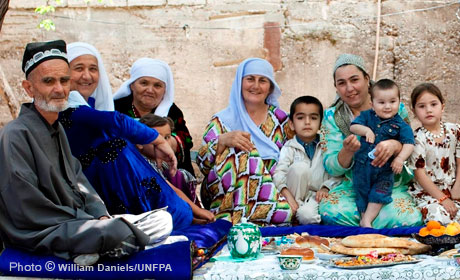
UNFPA Tajikistan
Since 1995, UNFPA has supported Tajikistan in strengthening the capacities of health professionals to provide reproductive and sexual health care, including to youth and other vulnerable groups, as well as assisting with the regular supply of contraceptives and other basic commodities. Programmes also develop national skills to collect, analyse and use reliable demographic information to plan and monitor development interventions, and respond to gender-based violence.
Key results of Tajikistan in 2021
View more

Please wait...
Programme Activities
Tajikistan 2022 Programme Activities data
Ending gender-based violence and harmful practices
By 2025, the reduction in gender-based violence and harmful practices has accelerated
Total Spending:
$889,815
Implemented by:
UNFPA $496,420
(56%)
NGO $287,968 (32%)
GOV $105,427 (12%)
NGO $287,968 (32%)
GOV $105,427 (12%)
Funded by:
Core Resources
(17%)
Non-core Resources (83%)
Non-core Resources (83%)
Adolescents and youth
By 2025, strengthened skills and opportunities for adolescents and youth to ensure bodily autonomy, leadership and participation, and to build human capital
Total Spending:
$32,266
Implemented by:
UNFPA $122
(0%)
NGO $32,144 (100%)
NGO $32,144 (100%)
Funded by:
Core Resources
(0)
Non-core Resources (100)
Non-core Resources (100)
Gender and social norms
By 2025, strengthened mechanisms and capacities of actors and institutions to address discriminatory gender and social norms to advance gender equality and women’s decision-making
Total Spending:
$416,120
Implemented by:
UNFPA $216,373
(52%)
NGO $199,747 (48%)
NGO $199,747 (48%)
Funded by:
Core Resources
(25)
Non-core Resources (75)
Non-core Resources (75)
Humanitarian action
By 2025, strengthened the capacity of critical actors and systems in preparedness, early action and in the provision of life-saving interventions that are timely, integrated, conflict- and climate-sensitive, gender-transformative and peace-responsive
Total Spending:
$563
Implemented by:
UNFPA $563
(100%)
Funded by:
Non-core Resources
(100)
Policy and accountability
By 2025, improved integration of sexual and reproductive health and reproductive rights, as well as the prevention of and response to gender-based violence and harmful practices, into universal health coverage-related policies and plans, and other relevant laws, policies, plans, and accountability frameworks
Total Spending:
$71,766
Implemented by:
UNFPA $50,548
(70%)
NGO $21,218 (30%)
NGO $21,218 (30%)
Funded by:
Core Resources
(43)
Non-core Resources (57)
Non-core Resources (57)
Population change and data
By 2025, strengthened data systems and evidence that take into account population changes and other megatrends (including ageing and climate change), in development policies and programmes, especially those related to sexual and reproductive health and reproductive rights
Total Spending:
$291,328
Implemented by:
UNFPA $213,985
(73%)
NGO $28,436 (10%)
GOV $48,907 (17%)
NGO $28,436 (10%)
GOV $48,907 (17%)
Funded by:
Core Resources
(7)
Non-core Resources (93)
Non-core Resources (93)
Quality of care and services
By 2025, strengthened capacity of systems, institutions and communities to provide high-quality, comprehensive sexual and reproductive health information and services, including supplies, as well as essential services to address gender-based violence and harmful practices
Total Spending:
$77,773
Implemented by:
UNFPA $14,829
(19%)
NGO $6,424 (8%)
GOV $56,520 (73%)
NGO $6,424 (8%)
GOV $56,520 (73%)
Funded by:
Core Resources
(-4)
Non-core Resources (104)
Non-core Resources (104)
Ending preventable maternal deaths
By 2025, the reduction of preventable maternal deaths has accelerated
Total Spending:
$1,076,033
Implemented by:
UNFPA $550,830
(51%)
NGO $388,153 (36%)
GOV $137,050 (13%)
NGO $388,153 (36%)
GOV $137,050 (13%)
Funded by:
Core Resources
(52%)
Non-core Resources (48%)
Non-core Resources (48%)
Adolescents and youth
By 2025, strengthened skills and opportunities for adolescents and youth to ensure bodily autonomy, leadership and participation, and to build human capital
Total Spending:
$132,443
Implemented by:
UNFPA $96,173
(73%)
NGO $36,269 (27%)
NGO $36,269 (27%)
Funded by:
Core Resources
(83)
Non-core Resources (17)
Non-core Resources (17)
Policy and accountability
By 2025, improved integration of sexual and reproductive health and reproductive rights, as well as the prevention of and response to gender-based violence and harmful practices, into universal health coverage-related policies and plans, and other relevant laws, policies, plans, and accountability frameworks
Total Spending:
$175,959
Implemented by:
UNFPA $58,353
(33%)
NGO $63,649 (36%)
GOV $53,957 (31%)
NGO $63,649 (36%)
GOV $53,957 (31%)
Funded by:
Core Resources
(81)
Non-core Resources (19)
Non-core Resources (19)
Population change and data
By 2025, strengthened data systems and evidence that take into account population changes and other megatrends (including ageing and climate change), in development policies and programmes, especially those related to sexual and reproductive health and reproductive rights
Total Spending:
$214,222
Implemented by:
UNFPA $156,272
(73%)
NGO $23,774 (11%)
GOV $34,177 (16%)
NGO $23,774 (11%)
GOV $34,177 (16%)
Funded by:
Core Resources
(20)
Non-core Resources (80)
Non-core Resources (80)
Quality of care and services
By 2025, strengthened capacity of systems, institutions and communities to provide high-quality, comprehensive sexual and reproductive health information and services, including supplies, as well as essential services to address gender-based violence and harmful practices
Total Spending:
$553,410
Implemented by:
UNFPA $240,032
(43%)
NGO $264,461 (48%)
GOV $48,917 (9%)
NGO $264,461 (48%)
GOV $48,917 (9%)
Funded by:
Core Resources
(48)
Non-core Resources (52)
Non-core Resources (52)
Ending the unmet need for family planning
By 2025, the reduction in the unmet need for family planning has accelerated
Total Spending:
$521,440
Implemented by:
NGO $171,807
(33%)
UNFPA $324,619 (62%)
GOV $25,014 (5%)
UNFPA $324,619 (62%)
GOV $25,014 (5%)
Funded by:
Core Resources
(78%)
Non-core Resources (22%)
Non-core Resources (22%)
Adolescents and youth
By 2025, strengthened skills and opportunities for adolescents and youth to ensure bodily autonomy, leadership and participation, and to build human capital
Total Spending:
$47,351
Implemented by:
UNFPA $5,800
(12%)
NGO $41,551 (88%)
NGO $41,551 (88%)
Funded by:
Core Resources
(100)
Humanitarian action
By 2025, strengthened the capacity of critical actors and systems in preparedness, early action and in the provision of life-saving interventions that are timely, integrated, conflict- and climate-sensitive, gender-transformative and peace-responsive
Total Spending:
$8,595
Implemented by:
NGO $8,595
(100%)
Funded by:
Core Resources
(100)
Policy and accountability
By 2025, improved integration of sexual and reproductive health and reproductive rights, as well as the prevention of and response to gender-based violence and harmful practices, into universal health coverage-related policies and plans, and other relevant laws, policies, plans, and accountability frameworks
Total Spending:
$80,343
Implemented by:
UNFPA $62,080
(77%)
NGO $15,264 (19%)
GOV $3,000 (4%)
NGO $15,264 (19%)
GOV $3,000 (4%)
Funded by:
Core Resources
(98)
Non-core Resources (2)
Non-core Resources (2)
Population change and data
By 2025, strengthened data systems and evidence that take into account population changes and other megatrends (including ageing and climate change), in development policies and programmes, especially those related to sexual and reproductive health and reproductive rights
Total Spending:
$66,737
Implemented by:
UNFPA $51,227
(77%)
NGO $7,770 (12%)
GOV $7,740 (12%)
NGO $7,770 (12%)
GOV $7,740 (12%)
Funded by:
Core Resources
(47)
Non-core Resources (53)
Non-core Resources (53)
Quality of care and services
By 2025, strengthened capacity of systems, institutions and communities to provide high-quality, comprehensive sexual and reproductive health information and services, including supplies, as well as essential services to address gender-based violence and harmful practices
Total Spending:
$318,413
Implemented by:
UNFPA $205,512
(65%)
NGO $98,627 (31%)
GOV $14,274 (4%)
NGO $98,627 (31%)
GOV $14,274 (4%)
Funded by:
Core Resources
(75)
Non-core Resources (25)
Non-core Resources (25)

